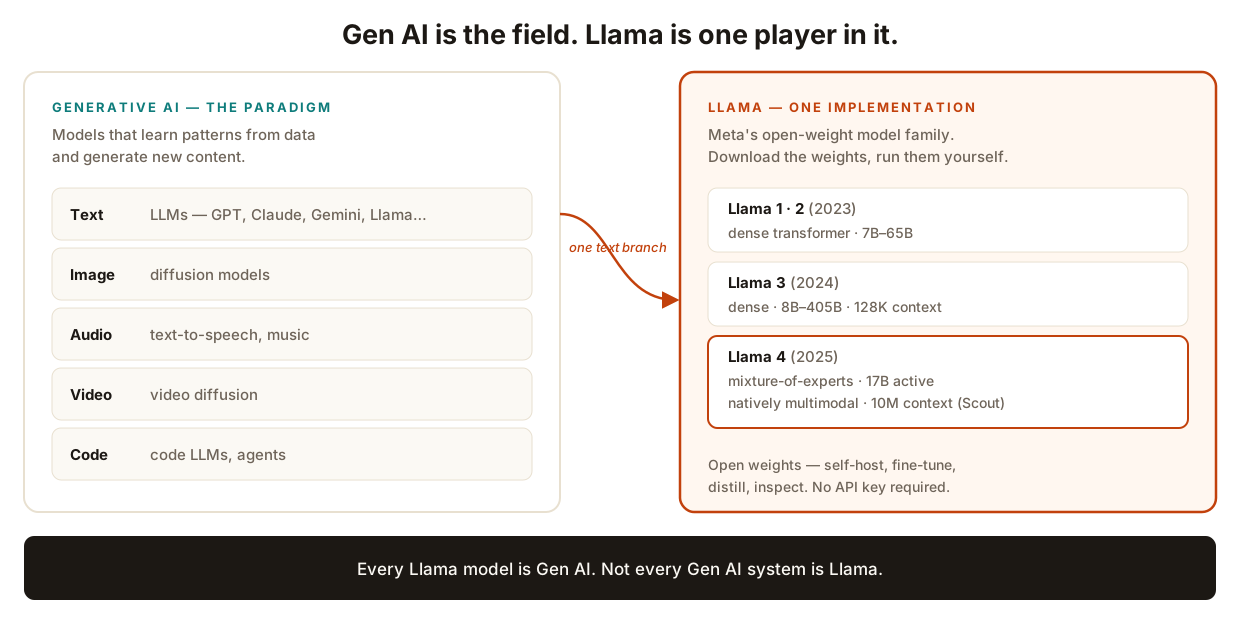
“Is Llama a Gen AI?” — I hear some version of this constantly, and it’s a fair question. The terms get thrown around interchangeably, but they refer to completely different levels of the stack. Generative AI is the field. Llama is one model family inside it — Meta’s open-weight one, which you can download and run yourself.
The differences, concretely
| Generative AI | Llama | |
|---|---|---|
| What it is | A paradigm: models that learn patterns from data and generate new content | A specific family of large language models built by Meta |
| Scope | Text, image, audio, video, code — any modality | Text (Llama 4 adds native image understanding) |
| You can download it? | Not a thing you download — it’s a category | Yes: open weights on Hugging Face, run with Ollama/vLLM |
| Examples | GPT-4, Claude, Gemini, Stable Diffusion, Suno… | Llama 3.3 70B, Llama 4 Scout, Llama 4 Maverick |
| Cost model | Depends on the product | Free weights; you pay for your own compute |
| Privacy | Depends on the vendor | Runs on your hardware — data never leaves |
The practical version: every Llama model is Gen AI, but most Gen AI systems you’ll touch — ChatGPT, Midjourney, Gemini — are not Llama.
When to reach for Llama specifically
Llama’s superpower isn’t raw capability (the closed models still trade blows at the top) — it’s control:
- Self-hosting & privacy. Regulated data, on-prem requirements, or just not wanting prompts leaving your network.
ollama runand you’re done. - Fine-tuning. Open weights mean you can adapt the model to your domain. Llama 3.3 70B remains the community’s favorite fine-tuning base because the ecosystem around it is mature.
- Cost at scale. API bills grow linearly with usage; a self-hosted model is a fixed hardware cost. At high volume the math flips fast (see the token bill).
- Offline & edge. Llama 3.2’s 1B/3B models run on-device — phones, laptops, places with no network.
- Research & inspection. You can look at the actual weights, activations, and attention patterns. Try doing that with a closed API.
The architecture: a decoder-only transformer, upgraded
Strip away the branding and Llama is a decoder-only transformer — the same skeleton as GPT. What made the Llama recipe influential is four specific upgrades over the vanilla transformer, applied together:
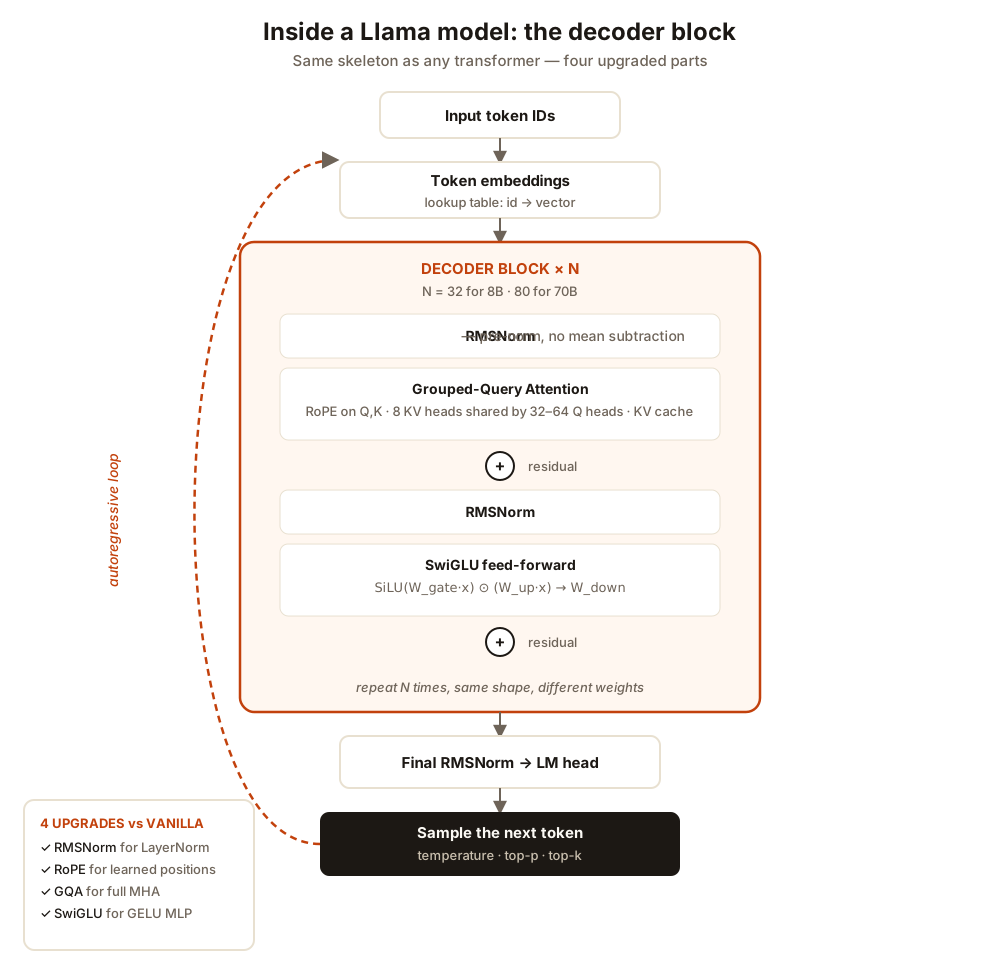
1. RMSNorm instead of LayerNorm. LayerNorm subtracts the mean and divides by the standard deviation. RMSNorm skips the mean subtraction and just normalizes by the root-mean-square. Fewer ops, no bias term, and in practice nothing was lost — training is just as stable.
2. RoPE instead of learned position embeddings. Rather than adding a position vector, RoPE rotates the query and key vectors by a position-dependent angle. The attention score between two tokens then depends on their relative distance — which is exactly what extrapolates better to long contexts. This is a big part of how Llama went from 2K to 128K (and now 10M) context windows.
3. Grouped-Query Attention instead of full multi-head attention. In vanilla MHA every query head gets its own key/value heads — and during generation, all those K/V vectors sit in the KV cache eating memory bandwidth. GQA shares: Llama 3 70B uses 64 query heads but only 8 KV heads, an 8× smaller cache. Same quality, far less memory pressure per token.
4. SwiGLU instead of a GELU MLP. The feed-forward network splits its up-projection in two and uses one half as a gate: W_down(SiLU(W_gate·x) ⊙ W_up·x). Three matrices instead of two, each narrower — roughly the same parameter count, consistently better results.
None of these changes what a transformer does. Together they buy ~30% fewer parameters at the same quality, faster training, and far better long-context behavior — which is why nearly every open model since has copied the recipe.
Llama 3 vs Llama 4: dense vs mixture-of-experts
| Llama 3 (2024) | Llama 4 (2025) | |
|---|---|---|
| Architecture | Dense — every parameter active on every token | MoE — a router activates a subset of “expert” networks per token |
| Sizes | 8B → 405B (all active) | Scout: 17B active / 109B total · Maverick: 17B active / 400B total |
| Context | 128K | Scout: 10M · Maverick: 1M |
| Modalities | Text (vision needed adapters) | Natively multimodal — text + image from the ground up |
| The trick | — | The knowledge of a huge model at the inference cost of a 17B one — but you still load all weights into memory |
MoE is the headline: only 17B parameters do work per token, so inference is fast, while the full 109B–400B of weights hold the knowledge. The catch the benchmarks don’t show: idle experts still occupy VRAM.
How generation actually works
Whatever the version, every Llama model writes the same way — one token at a time, in a loop:
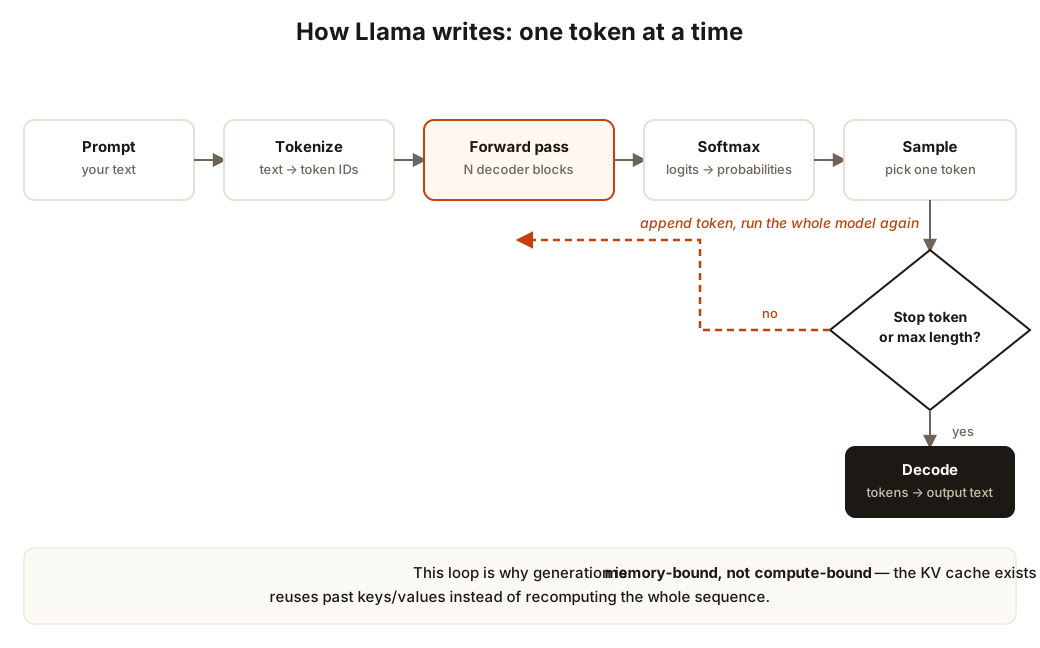
The step most people never think about is sampling. The model doesn’t output “the answer” — it outputs a probability distribution over its entire vocabulary, and you pick from it. Temperature controls how sharp that distribution is. Try it:
Low temperature collapses onto the most likely token (deterministic, boring, safe). High temperature flattens the distribution and lets long-shots win (creative, surprising, occasionally unhinged). Every “the model is being creative today” story is mostly this slider.
Run one yourself
The whole point of Llama is that the weights are yours to run. The fastest path:
# Install from ollama.com, then:
ollama run llama3.3:70b
Or in Python with Hugging Face Transformers:
from transformers import pipeline

gen = pipeline("text-generation", model="meta-llama/Llama-3.3-70B-Instruct")
out = gen("Explain grouped-query attention in one paragraph.",
          max_new_tokens=120, temperature=0.7, do_sample=True)
print(out[0]["generated_text"])
You’ll need a Hugging Face account and access approval for Meta’s models (a click-through license), plus serious VRAM for the 70B — the 8B fits on a single consumer GPU and is the right starting point for experiments.
The takeaway
Gen AI is what — the idea that models can generate text, images, code, and more. Llama is one concrete how — an open-weight family of text models with a well-understood transformer recipe (RMSNorm, RoPE, GQA, SwiGLU) that you can download, run, fine-tune, and inspect. When someone says “we’re using Gen AI,” ask which model. When they say “we’re using Llama,” ask which version — the answer changes the architecture, the context window, and the hardware bill.
Sources: Meta’s Llama 4 announcement (Apr 2025); Llama 4 API guide; running Scout & Maverick locally; Llama 3 from-scratch implementation; modern transformer consensus stack.